Editorial Standards
This article is written by the Gradily team and reviewed for accuracy and helpfulness. We aim to provide honest, well-researched content to help students succeed. Our recommendations are based on independent research — we never accept paid placements.
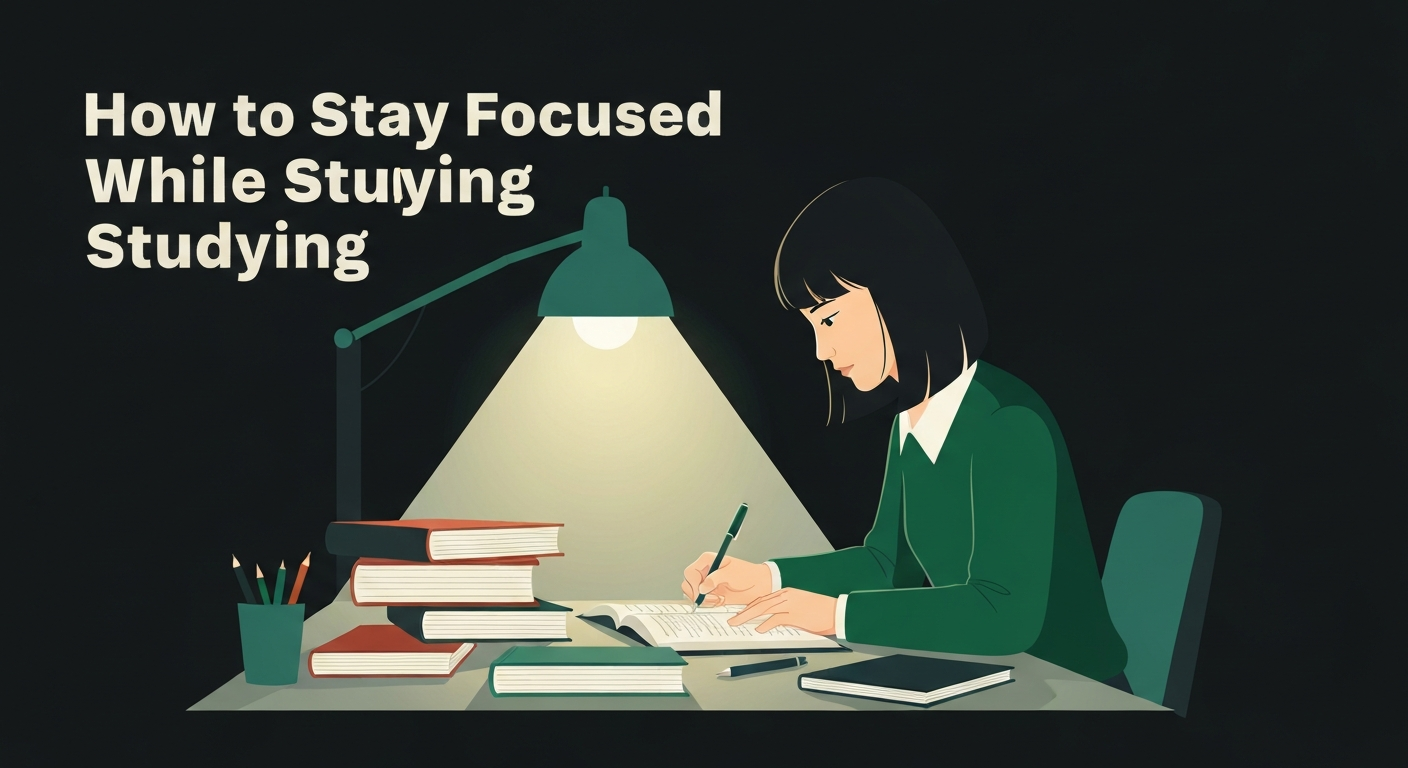
How to Stay Focused While Studying
Is your attention span shrinking? Learn the science-backed strategies to eliminate distractions, enter a 'flow state,' and get your homework done in half the time.
Table of Contents
TL;DR
- Environment is everything. Your brain associates locations with activities. Don't study in bed.
- Your phone is the enemy. Put it in another room. "Do Not Disturb" isn't enough.
- Use the Pomodoro Technique. 25 minutes of focus, 5 minutes of rest.
- Monotask. Multitasking is a myth that reduces your IQ by 10 points.
- Manage your "Internal Distractions." Use a "Brain Dump" list for random thoughts.
- Gradily can help. Use AI to clear the "confusion roadblocks" that make you want to quit.
We live in the age of the "Attention Economy." Apps like TikTok, Instagram, and YouTube are designed by literal geniuses whose only goal is to keep you scrolling. Your brain is being trained to want a new hit of dopamine every 15 seconds.
Then, you sit down and try to read a 40-page chapter on Macroeconomics.
It’s no wonder you feel like you can't focus. Your brain is a high-performance engine that has been idling in traffic for years, and now you’re asking it to run a marathon. The good news? Focus is a muscle. You can train it. Here is how to reclaim your attention and get your work done faster than ever.
1. Design Your "Deep Work" Sanctuary
Willpower is a finite resource. If you have to fight the urge to check your phone 100 times, you'll be too tired to actually learn anything. Instead of using willpower, use environment design.
- The Bedroom Rule: Never study in bed. Your brain associates your bed with sleep and relaxation. If you study there, you'll either get sleepy while studying or develop insomnia at night.
- The Visual Cue: Have a specific "Study Mode" for your environment. Maybe it’s a specific desk lamp you only turn on when you're working, or a specific playlist.
- The "Nuclear Option" for Phones: Don't just put your phone face down. Put it in a drawer, in another room, or give it to a friend. The mere presence of a smartphone reduces cognitive capacity, even if it's off.
2. The Myth of Multitasking
Many students think they are "great multitaskers." They have a lecture video playing, a group chat open, and a textbook in their lap.
Science has a different name for this: Context Switching.
Every time you switch from your essay to a text message, there is an "attention residue" that stays on the text message. It takes your brain about 10-15 minutes to fully refocus on the essay. If you check your phone every 10 minutes, you are never fully focused. You are essentially working with a "brain fog" that makes everything take twice as long.
3. Use the Pomodoro Technique (And Its Variations)
Your brain is not designed to focus for four hours straight. It works best in pulses.
- Classic Pomodoro: 25 minutes of work / 5 minutes of break.
- The 50/10: 50 minutes of deep work / 10 minutes of break. (Best for writing or complex math).
- The Break Rule: During your break, do not check social media. That’s just more digital input. Instead, stand up, stretch, get water, or look out a window. Give your "focus muscles" a chance to actually relax.
4. Master Your Internal Distractions
Sometimes the distraction isn't your phone; it's your own brain. "Did I email my boss?" "I wonder what the weather is tomorrow." "I'm hungry."
When these thoughts pop up, don't follow them. Keep a "Brain Dump" notebook next to your laptop. Write the thought down and tell yourself, "I will deal with this during my break." Once it’s on paper, your brain can stop worrying about it and get back to work.
5. Clear the "Confusion Roadblocks"
Most of the time when we "lose focus," it’s actually because we hit a part of the homework that is too hard. We get frustrated, and our brain looks for an "escape" (like Instagram).
When you hit a wall, don't quit. This is where Gradily comes in.
- Stuck on a sentence? Ask Gradily to explain the concept in simpler terms.
- Can't find the next step? Use Gradily to get a hint. Once the "confusion" is cleared, your focus will naturally return. Focus thrives on a sense of progress.
6. Digital Tools for Focus
If you struggle with self-control, let technology help you:
- Freedom / Cold Turkey: Apps that block specific websites and apps across all your devices for a set time.
- Forest: A mobile app where you "plant a tree" that only grows if you stay off your phone.
- Gradily: Instead of having 20 tabs open to research a topic, use Gradily to synthesize the information in one place. Less tabs = less distractions.
7. The Role of Physical Health
You can't focus if your "hardware" is failing.
- Sleep: A sleep-deprived brain looks almost identical to a drunk brain on an MRI. If you didn't sleep, don't bother trying to do "deep work."
- Hydration: Even 2% dehydration causes a massive drop in concentration.
- Caffeine: Use it strategically. If you drink coffee all day, you'll just get the jitters. Save it for your most difficult study block.
How to Enter the "Flow State"
Flow is that magical feeling where time disappears and you're perfectly "in the zone." To get there, you need:
- Clear Goals: Know exactly what you are trying to achieve in this session.
- Immediate Feedback: Knowing if you're doing it right (this is why Gradily is great for flow).
- The Challenge-Skill Balance: The task must be hard enough to be interesting, but not so hard that it's overwhelming.
Final Thoughts
Focus is not a gift you're born with; it’s a habit you build. In 2026, the ability to focus is a "superpower" because so few people can do it. If you can learn to put your phone away and give your full attention to one task for just two hours a day, you will accomplish more than most people do in a week.
Start small. Set a timer for 20 minutes right now. Put your phone in another room. See how it feels to actually finish something without being interrupted.
You might find that you actually enjoy the work when you give yourself the chance to do it well.
Read more on productivity:
Ready to ace your classes?
Gradily learns your writing style and completes assignments that sound like you. No credit card required.
Get Started Free