Editorial Standards
This article is written by the Gradily team and reviewed for accuracy and helpfulness. We aim to provide honest, well-researched content to help students succeed. Our recommendations are based on independent research — we never accept paid placements.
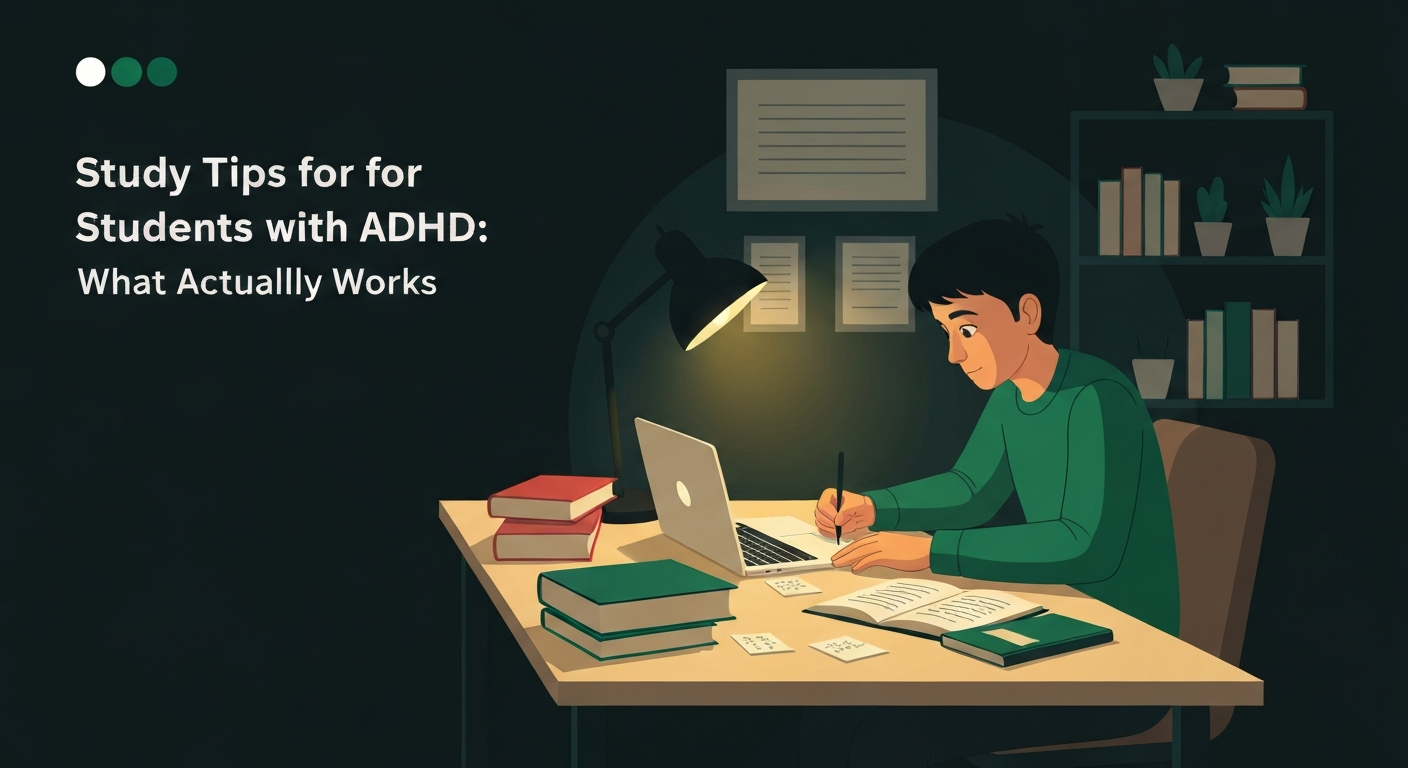
Study Tips for Students with ADHD: What Actually Works
Evidence-based study strategies for ADHD students. No generic advice - just practical techniques that work with your brain, not against it.
Table of Contents
TL;DR
- Traditional study advice ("just sit down and focus") doesn't account for how ADHD brains actually work
- External structure, body doubling, movement breaks, and novelty-driven study methods are backed by research
- The biggest game-changer for most ADHD students is building systems that don't rely on willpower or memory
- Shorter, more frequent study sessions consistently outperform long marathon sessions for ADHD brains
Table of Contents
- Why Traditional Study Advice Fails ADHD Students
- How ADHD Affects Studying (The Science)
- 12 Study Tips for ADHD Students That Actually Work
- How to Set Up Your Study Environment for ADHD
- ADHD-Friendly Study Schedules
- When to Get Help
- FAQ
Why Traditional Study Advice Fails ADHD Students
Most study guides assume that you can simply decide to focus and then do it. For students with ADHD, this is like telling someone with poor eyesight to "just see better." The issue isn't motivation or intelligence. It's a neurological difference in how your brain manages attention, prioritizes tasks, and transitions between activities.
According to research by DuPaul et al. (2021), college students with ADHD receive lower GPAs, use fewer study strategies, make slower academic progress, and persist for fewer semesters than their non-ADHD peers. But these outcomes aren't inevitable. They reflect a mismatch between conventional academic structures and ADHD brain wiring, not a lack of ability.
The study tips in this guide are designed specifically for ADHD brains. They don't require you to "just try harder." They work with your neurology instead of against it.
How ADHD Affects Studying (The Science)
Understanding why your brain does what it does makes it easier to build effective strategies. Here are the core ADHD challenges that affect studying:
Executive Function Deficits
Executive function is the brain's project manager. It handles planning, prioritizing, starting tasks, tracking time, and switching between activities. ADHD impairs all of these functions, which is why you can know an assignment is due tomorrow and still not start it until midnight.
This isn't laziness. Your prefrontal cortex, the region responsible for executive function, operates with lower dopamine levels in ADHD brains. Dopamine is the neurotransmitter that helps you feel motivated to do things that aren't immediately rewarding.
Attention Regulation (Not Deficit)
The name "Attention Deficit" is misleading. ADHD doesn't mean you lack attention. It means you struggle to regulate where your attention goes. You can hyperfocus on a video game for 6 hours but can't maintain focus on a textbook for 20 minutes. That's not a deficit of attention. It's a deficit of control over attention.
This means your study strategies need to make the task itself more engaging, not just tell you to "pay attention."
Time Blindness
Many people with ADHD experience "time blindness," which is a difficulty in perceiving how much time has passed and how long tasks will take. This makes planning study sessions extremely hard and is why ADHD students are disproportionately affected by procrastination.
Working Memory Limitations
Working memory is your brain's scratchpad. It holds information temporarily while you work with it. ADHD often comes with reduced working memory capacity, which means you might read a paragraph and immediately forget what it said, or lose your train of thought mid-sentence while writing an essay.
12 Study Tips for ADHD Students That Actually Work
1. Use External Timers, Not Internal Motivation
Don't rely on your brain to tell you when to start, how long to work, or when to take a break. Use external tools:
- Visual timers (Time Timer is popular) that show time as a shrinking colored disc
- The Pomodoro Technique with 15-minute intervals instead of the standard 25 (shorter blocks work better for many ADHD students)
- Phone alarms for task transitions ("stop reading, start practice problems")
The key is externalizing time management so your brain doesn't have to do it. We have a full guide on the Pomodoro Technique for students with specific ADHD adaptations.
Why this works: Research shows that ADHD brains respond better to external cues than internal motivation for task management. External timers replace the executive function that regulates time awareness.
2. Try Body Doubling
Body doubling means studying in the presence of another person, even if they're working on something completely different. For many ADHD students, having someone else in the room creates just enough social accountability to maintain focus.
Options for body doubling:
- Study with a friend at the library (you don't need to study the same subject)
- Join a virtual co-working session (sites like Focusmate pair you with a stranger via video for 25-minute work blocks)
- Watch "study with me" videos on YouTube (surprisingly effective as a virtual body double)
- Work in a coffee shop where other people are also working
Why this works: The presence of another person activates mild social accountability and provides environmental stimulation that helps ADHD brains maintain focus. Multiple studies on social facilitation support this effect.
3. Move Your Body Before and During Study Sessions
Exercise isn't just good general advice. It has specific benefits for ADHD. A meta-analysis published in the Journal of Attention Disorders found that acute exercise improves attention and executive function in individuals with ADHD.
Practical applications:
- Before studying: 15-20 minutes of cardio (walk, jog, bike ride, jumping jacks). This primes your brain for focus.
- During breaks: Stand up, stretch, do pushups, or walk around the building. Physical movement resets your attention.
- While studying: Pace while reviewing flashcards. Use a standing desk. Sit on an exercise ball. Fidget with a tactile toy. Movement doesn't have to mean leaving your study space.
Why this works: Exercise increases dopamine and norepinephrine levels in the brain, both of which are lower in ADHD brains and are targeted by ADHD medications. Exercise is essentially a mild, natural version of the same mechanism.
4. Make Material Novel and Engaging
ADHD brains are interest-driven, not importance-driven. You can't force yourself to care about something boring, but you can make boring material more engaging:
- Teach it to someone else (or pretend to). Explaining a concept out loud forces active processing.
- Create visual notes with colors, diagrams, and doodles instead of linear text notes.
- Turn studying into a game. Quiz yourself with flashcards and keep score. Challenge yourself to beat your previous score.
- Use different media. If the textbook is putting you to sleep, find a YouTube video on the same topic, then a podcast, then return to the textbook.
- Change locations. Study the same material in different places. Research shows that changing your study environment can improve recall.
Why this works: Novelty stimulates dopamine release. By varying how you interact with material, you create enough novelty to keep your brain engaged.
5. Build an "ADHD-Proof" Task System
Your brain will forget things. Accept this and build a system that catches what your memory drops:
- One task list in one place. Don't scatter tasks across sticky notes, apps, and your memory. Use one system (Notion, Todoist, a paper planner, whatever you'll actually check).
- Write due dates in two places: your planner and your phone calendar with alerts.
- Set three alarms for important deadlines: one a week before, one the day before, one the day of.
- Break every assignment into the smallest possible steps. Not "write essay" but "read prompt," "brainstorm 5 ideas," "pick thesis," "outline paragraph 1," etc.
Why this works: Externalized systems compensate for working memory limitations. You're not trying to improve your memory; you're bypassing it entirely.
6. Use the "2-Minute Start" Rule
The hardest part of studying with ADHD is starting. The gap between "I should study" and "I'm studying" can feel like crossing a canyon.
The trick: commit to starting for only 2 minutes. Open your textbook and read one paragraph. Open your laptop and type one sentence. That's it. If you want to stop after 2 minutes, you can.
But most of the time, you won't stop. Starting is the barrier, not continuing. Once you're in motion, momentum carries you forward.
Why this works: Task initiation is one of the executive functions most impaired by ADHD. By making the initial task absurdly small, you lower the activation energy required to begin.
7. Study in Shorter, More Frequent Sessions
Three 30-minute sessions spread across the day consistently outperform one 90-minute session for ADHD students. Your attention fades faster, so work with that rather than against it.
A sample daily study schedule:
- Morning (before class): 25-minute review session of yesterday's material
- Afternoon (between classes): 30-minute active study session (practice problems, flashcards)
- Evening: 25-minute session for new material + planning tomorrow
That's 80 minutes of study time, but spread across the day so no single session overwhelms your attention span.
Why this works: Distributed practice is more effective than massed practice for all learners, but the effect is even larger for students with attention regulation challenges. Shorter sessions also align with the attention windows that ADHD brains naturally operate in.
8. Use Active Study Methods (Passive Reading Doesn't Work for You)
Reading and rereading a textbook is the least effective study method for ADHD brains. Your eyes will scan the page while your mind thinks about something else entirely. You'll reach the end of a chapter and realize you absorbed nothing.
Active methods that force engagement:
- Active recall: Close the book and write down everything you remember. Then check what you missed.
- Practice problems: For any subject that has them, do problems instead of reading about how to do problems.
- Cornell notes: Divide your page into sections with questions on the left and notes on the right. Cover the right side and quiz yourself using the questions.
- Voice recording: Record yourself explaining concepts, then listen back during commutes or walks.
- Whiteboard/sketch notes: Recreate diagrams, charts, and concept maps from memory on a whiteboard.
Why this works: Active learning requires ongoing cognitive engagement, which prevents the attention drift that makes passive reading useless for ADHD brains. The "testing effect" (actively retrieving information) is also one of the strongest findings in learning science.
9. Manage Your Study Environment
Your environment either helps or hurts your focus. For ADHD brains, environment matters significantly more than for neurotypical students.
Sound: Some ADHD students need silence; others need background noise to focus. Experiment to find your ideal. Options include library silence, coffee shop ambient noise, lo-fi music playlists, or brown noise generators.
Visual distractions: Face a wall, not a window or high-traffic area. Keep your desk clear of everything except what you're currently working on. If your phone is visible, it's a distraction.
Lighting: Natural light is ideal. If that's not available, bright, cool-toned light helps maintain alertness.
Temperature: Slightly cool is better than warm. Warm environments promote drowsiness.
What this looks like in practice: Find 2-3 "study spots" that work for you and rotate between them. Having dedicated study locations helps your brain associate those spaces with focused work.
10. Use Strategic Procrastination
This sounds counterintuitive, but hear it out. If you can't start the task you're supposed to do, start a different productive task. Can't write your essay? Organize your notes. Can't do math problems? Review flashcards for another class.
The goal is to redirect your brain's resistance toward something productive rather than toward social media or gaming. You're still making academic progress even if it's not on the "right" task.
Once you build momentum on the easier task, switching to the harder one becomes more feasible.
Why this works: This technique, sometimes called "structured procrastination," gives your brain a sense of autonomy (you're choosing what to work on) while still producing useful output. For ADHD brains that resist external demands, this sense of choice reduces the emotional resistance to starting.
11. Eat, Sleep, and Exercise on a Schedule
This isn't generic wellness advice. For ADHD brains, basic physiological regulation has an outsized impact on cognitive performance.
Sleep: Adults with ADHD have a significantly higher risk of sleep problems (research estimates 50-75% of ADHD adults have sleep difficulties). Poor sleep directly worsens every ADHD symptom. Set a consistent bedtime and wake time, even on weekends. Blue light glasses or night mode on your devices in the evening can help.
Food: Blood sugar crashes destroy focus. Eat regular meals with protein and complex carbs. Keep study snacks nearby so you don't lose 30 minutes going to get food when you're hungry.
Exercise: As discussed earlier, regular exercise is one of the most effective non-medication interventions for ADHD. Even 15 minutes of cardio before a study session makes a measurable difference.
12. Know Your Peak Hours and Use Them
Track your focus levels for a week. Most people with ADHD have specific windows where focus comes more easily. For many, it's mid-morning (9-11 AM) or late evening (9 PM-midnight). Your peak hours might be different.
Once you know your peak times, schedule your hardest study tasks during those windows. Save low-focus tasks (organizing notes, formatting documents, reviewing flashcards) for your low-energy periods.
This is about working smarter, not harder.
How to Set Up Your Study Environment for ADHD
Here's a practical checklist:
Physical space:
- Desk clear of non-study items
- Phone in another room or in a locked pouch (check out kSafe or a phone jail box)
- Water bottle and snacks within reach
- Comfortable chair but not too comfortable (not a bed or couch)
- Headphones if you need sound management
Digital space:
- Close all non-essential browser tabs
- Use a website blocker (Freedom, Cold Turkey, or StayFocusd)
- Set devices to Do Not Disturb
- Keep only the current document/assignment visible on screen
Support tools:
- Timer (visual timer, phone alarm, or Pomodoro app)
- Task list with today's specific goals
- Fidget toy or tactile item if you're a fidgeter
- Scratch paper for random thoughts that pop up (write them down and get back to work)
ADHD-Friendly Study Schedules
The Burst Schedule (for high-inattention days)
- 15 min study
- 5 min movement break
- 15 min study (different subject or different method)
- 5 min break
- 15 min study
- 15 min long break
- Repeat if energy allows
Total: 45 minutes of focused study per cycle. Low individual commitment. High cumulative output.
The Deep Work Schedule (for hyperfocus-capable days)
- 45-60 min study (ride the hyperfocus wave)
- 15 min movement break
- 45-60 min study
- 30 min long break
- Optional: one more cycle
Total: 90-120 minutes of deep work. Use this when your brain clicks into gear.
The Distributed Schedule (spread across the day)
- Morning: 20 min review session before first class
- Between classes: 25 min active study
- After lunch: 20 min practice problems
- Evening: 30 min new material + planning
Total: 95 minutes spread across 4 sessions. No single session exceeds 30 minutes.
When to Get Help
Study strategies can make a significant difference, but they're not a replacement for professional support when you need it.
Talk to your school's disability services office if:
- You have an ADHD diagnosis and haven't registered for accommodations
- You need extended time on exams, a distraction-reduced testing environment, or note-taking support
- Your academic performance doesn't reflect your actual understanding of the material
Talk to a healthcare provider if:
- Your ADHD symptoms are significantly impacting your grades, relationships, or daily functioning
- You're not currently receiving treatment and want to explore options
- You suspect you have ADHD but haven't been diagnosed
Consider ADHD coaching if:
- You have strategies that work in theory but you can't consistently implement them
- You need regular accountability check-ins
- You want personalized support from someone who understands ADHD
Many universities offer free counseling and ADHD coaching through student health services. It's worth checking what's available at your school.
If you're looking for a study tool that works well with ADHD-friendly techniques, Gradily adapts to shorter study bursts and explains concepts in different ways, which helps when your brain needs novelty to stay engaged.
FAQ
Can I study effectively with ADHD without medication?
Yes, many students manage ADHD successfully through behavioral strategies, environmental modifications, exercise, and structured routines. Medication can be very effective, but it's not the only path. The strategies in this guide work both with and without medication. If you're currently on medication, these techniques can enhance its effectiveness. If you're not, they can partially compensate for the cognitive challenges ADHD creates.
What's the best study method for ADHD?
Active recall (testing yourself on material) combined with spaced repetition (reviewing at increasing intervals) is the most evidence-supported combination for all learners, and it works particularly well for ADHD students because both methods force active engagement. Passive methods like rereading and highlighting are especially ineffective for ADHD brains.
How long should ADHD students study at a time?
Start with 15-20 minute focused blocks and adjust based on your experience. Some ADHD students work well in 25-minute Pomodoro blocks. Others need shorter intervals of 10-15 minutes. On hyperfocus days, you might sustain 45-60 minutes. The key is matching your study blocks to your actual attention span, not to what a study guide says it should be.
Why can I focus on video games but not homework?
Video games are designed to provide constant, immediate feedback, novelty, and reward, all of which activate the dopamine system that ADHD brains struggle with. Homework typically provides none of these. This doesn't mean you're lazy or choosing to be unfocused. It means your brain's reward system responds to stimulation patterns that textbooks don't provide. The strategies above (gamification, novelty, body doubling, movement) are attempts to add some of those engagement elements to studying.
Does coffee help ADHD studying?
Caffeine is a mild stimulant that can temporarily improve attention in people with ADHD. Some students find that coffee before a study session helps them focus. However, caffeine can also increase anxiety, disrupt sleep (which worsens ADHD symptoms), and has diminishing returns with regular use. If you use caffeine, keep it moderate (1-2 cups) and stop consumption by early afternoon to protect your sleep.
How do I handle exam anxiety with ADHD?
ADHD and anxiety frequently co-occur. For exam preparation, start studying well in advance (to avoid the anxiety of cramming), use practice exams to simulate test conditions, and develop a pre-exam routine (exercise, breathing exercises, familiar music). Register for extended time accommodations through your school's disability services if you haven't already. Extended time doesn't mean you need it; it means you have a buffer that reduces the time pressure that exacerbates both ADHD and anxiety symptoms.
Ready to ace your classes?
Gradily learns your writing style and completes assignments that sound like you. No credit card required.
Get Started Free