Editorial Standards
This article is written by the Gradily team and reviewed for accuracy and helpfulness. We aim to provide honest, well-researched content to help students succeed. Our recommendations are based on independent research — we never accept paid placements.
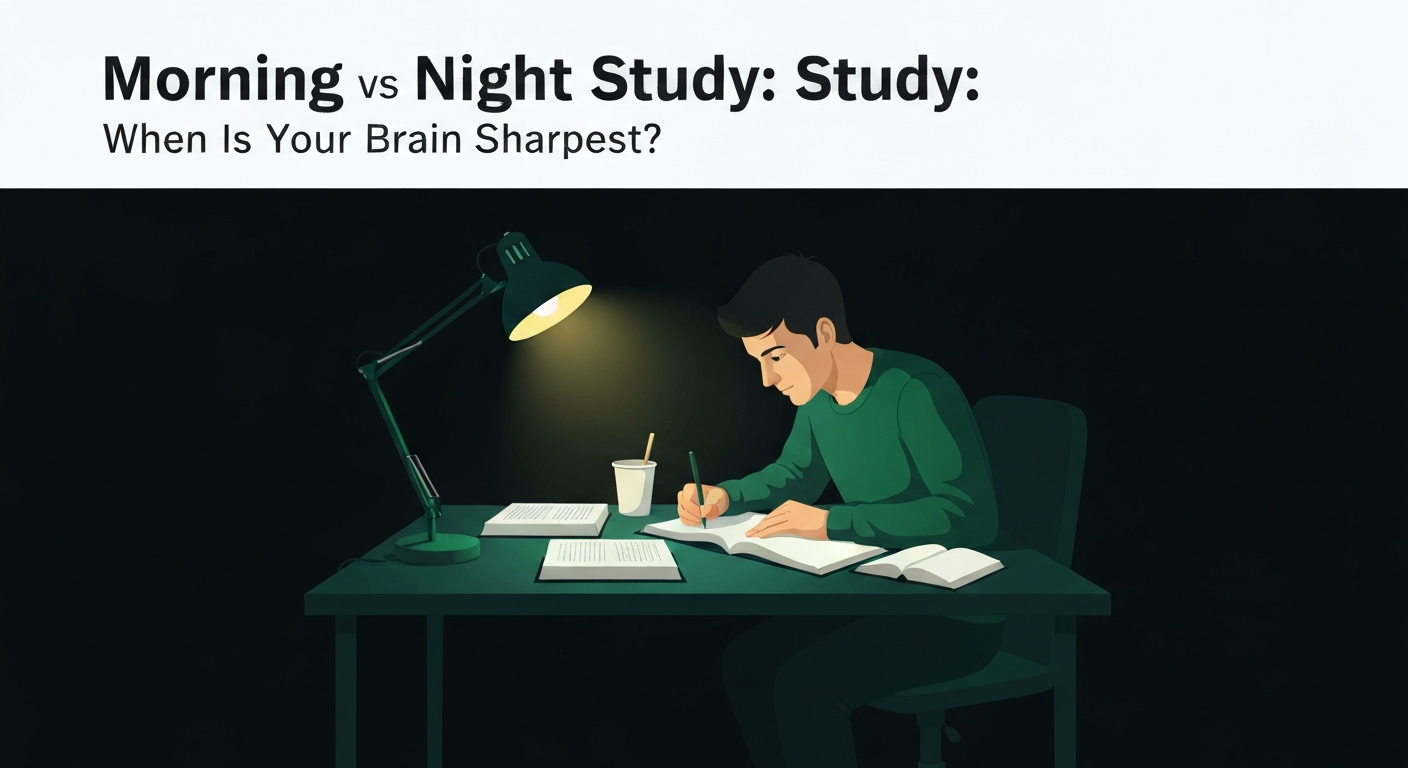
Morning vs Night Study: When Is Your Brain Sharpest?
Are you a morning person or a night owl? Learn the science of chronotypes and find out the best time for you to study, write, and take exams.
Table of Contents
TL;DR
- There is no "best" time for everyone. It depends on your biological "chronotype."
- Morning (8 AM - 12 PM) is generally best for logical, analytical work and math.
- Afternoon (2 PM - 5 PM) is often a "slump" time—best for administrative tasks or light review.
- Late Afternoon/Evening (5 PM - 9 PM) is when many people experience a "second wind" of creativity.
- Consistency is key. Your brain learns when to expect a "work block" and prepares accordingly.
- Listen to your body. If you're nodding off at 10 PM, don't force a study session.
We’ve all seen the "5 AM Club" videos on YouTube. You know the ones: the student who wakes up while it’s still dark, drinks a green smoothie, and has finished three chapters of Chemistry before the sun comes up.
It makes you feel like if you aren't a "morning person," you're failing at being a student. But then you talk to the "Night Owls" who swear they do their best writing at 2 AM when the rest of the world is silent.
So, who’s right? Science says: both of them. The secret to being a high-achieving student isn't waking up early—it's understanding your Chronotype.
1. What is a Chronotype?
Your chronotype is your body's natural inclination to sleep at a certain time. It's dictated by your circadian rhythm, which controls your body temperature, hormone levels, and alertness throughout the day.
Most people fall into one of three categories:
- Larks (Morning People): Peak alertness happens early. They are great at 8 AM classes but "crash" by 9 PM.
- Owls (Night People): Peak alertness happens late. They struggle to wake up but find their "flow" in the evening.
- Third Birds (The Middle): Most people fall here. They wake up naturally around 7-8 AM and have a peak in the morning, a slump in the afternoon, and a second wind in the early evening.
2. The Case for Morning Studying
If you are a Lark or a Third Bird, your brain is generally most "logical" in the morning.
- The Analytical Peak: Research shows that our ability to process new information and solve complex problems peaks a few hours after we wake up.
- Willpower: Willpower is like a battery. In the morning, it's fully charged. It's much easier to stay focused on a hard task when you haven't yet been stressed by the rest of your day.
- Natural Light: Daylight signals to your brain that it’s time to be alert.
Best morning tasks: Math, Science, New Concepts, Hard Problem Sets.
3. The Case for Night Studying
Night Owls aren't just lazy; their brains actually work differently.
- The "Creative Wind": Many people find that as the analytical "filter" of the brain tires out in the evening, they become more creative. This is why many writers prefer the night.
- Silence: For many students, the best part about night studying is the lack of distractions. No emails, no texts, and no one walking into your room.
- Sleep Consolidation: Studying right before bed can actually help with spaced repetition. Your brain processes information during sleep, so the "last thing in" is often the best-remembered.
Best night tasks: Writing, Brainstorming, Reviewing Flashcards, Creative Projects.
4. How to Manage the "Afternoon Slump"
Regardless of your chronotype, almost everyone experiences a dip in energy between 2 PM and 5 PM. This is caused by a natural drop in body temperature.
What NOT to do: Don't try to learn a complex new theory during the slump. You'll just get frustrated and quit. What TO do: Use this time for "Low Energy" work.
- Organizing your notes.
- Checking emails.
- Planning your study schedule.
- Doing a light workout or taking a nap.
5. How to Find YOUR Best Time
Don't guess; track. For three days, rate your "Mental Alertness" on a scale of 1-10 every hour that you're awake.
- You’ll likely see a pattern emerge.
- Once you find your "High Alertness" blocks, protect them! Don't waste your 10/10 brainpower on laundry or scrolling TikTok.
6. The Role of Sleep Hygiene
Whatever time you choose to study, it won't work if you aren't sleeping.
- The 7-Hour Rule: If you study until 3 AM but have to wake up at 7 AM for class, you are losing more than you're gaining. A sleep-deprived brain cannot form long-term memories.
- Blue Light: If you study late at night, use a blue-light filter (like Night Shift or f.lux). Blue light tells your brain the sun is up, which prevents the production of melatonin and ruins your sleep quality.
How Gradily Works With Your Schedule
At Gradily, we're available 24/7.
- The Late Night Savior: If it’s 1 AM and you’re stuck on a problem, you can't exactly email your professor. Gradily is there to clear the roadblock instantly so you can stay in your flow.
- The Morning Planner: Use Gradily in the morning to break down your massive to-do list into "Sprints" based on your energy levels.
- Quick Refresher: If you have an afternoon slump, ask Gradily for a "3-minute summary" of your morning notes to keep the info fresh without overtaxing your brain.
Final Thoughts
The "best" time to study is the time when you can actually get work done. If you're a night owl, stop feeling guilty about sleeping in. If you're a lark, stop forcing yourself to stay up late with your friends.
Work with your biology, not against it. When you align your hardest tasks with your highest energy, you’ll find that you can get more done in two hours than most people do in a whole day.
Now, look at the clock. Is your brain sharp right now? If yes, go study. If no, go take a nap!
Read Next:
Ready to ace your classes?
Gradily learns your writing style and completes assignments that sound like you. No credit card required.
Get Started Free